Many artists have dedicated a large section to examining how theorganand its artistic styles have influenced the largest religious buildings (churches, chapels, convents, and cloisters). Keith Morgan’s The Evolution of the Early English Organ explores the history of the English organ, including its development and use in England before 1660. The book traces its origins, changing roles in worship and culture, and evolving design, drawing on manuscripts and church records. It also provides useful tables, illustrations, and appendices for researchers and enthusiasts.
From Sacred Halls to Sonic Marvels: The Organ’s Role in English Churches
When we dive into the history of the English organ, this wind instrument is capable of producing the greatest sonic effects, and Mozart rightly called it “the king of instruments.” It was invented in Alexandria in the 3rd century BC, and by the 2nd century AD, the organ had become one of the principal instruments in Rome and could be heard at all kinds of Roman entertainments: theatre, games, gladiatorial combats, in the circus, and at banquets. Focusing on our immediate surroundings, it is worth noting that an English organ has significant cultural and historical value and should be preserved and valued by the community. Therefore, the main objective of this book is to highlight the unique characteristics of this heritage and its importance as a cultural asset.
Ancient Echoes: The Story of Early Organs
The direct predecessor of the modern pipe organ is the “hydraulis” (hydraulos), invented by Ctesibius, considered the “father of the organ.” In the hydraulis, water maintains air pressure, but the sound is produced by air flowing through bronze pipes of varying lengths. It was described as a flute played with the hands.
Originally, it had a single row of pipes, but over time, more were added, eventually reaching six, seven, or even eight (3rd century AD). It was said that the water organ was so loud that those who played it had to cover their ears. The biggest drawback to using water was the constant, precise maintenance required to prevent corrosion of the container, so, over time, it was replaced by an air chamber powered by bellows and compressed air.
In the 10th century, the organ returned to Europe via Byzantium. Between the 10th and 13th centuries, it became used almost exclusively for religious purposes. Over the centuries, changes included the addition of the fingerboard, footboard, black keys, more pipes, and a greater variety of timbres.
For several centuries, churches had relatively small organs, and by the 15th century, newly built churches were incorporating an organ as an integral part of the structure.
From Water Wonders to Wind Power: The Hydraulis
The direct ancestor of today’s pipe organ is the hydraulis. Invented by Ctesibius of Alexandria, it used water pressure to maintain a steady airflow to the pipes, combining hand pumps and water pressure. Maintenance difficulties with water systems led to their replacement by bellows and compressed air.
Milestones and Innovations: The Organ’s English Journey
As the organ matured, modifications reflected new musical needs. Over time, more pipes were incorporated, and a movable wooden stop was introduced, allowing musicians to control which pipes sounded. This innovation marked the origin of the stops and sound-defining mechanisms found on present-day organs. A keyboard was added, enabling the creation of composed music rather than random sounds. This introduced mechanical action. The water cylinder was replaced with bellows as water caused rust, and the instrument could then grow in size with adequate air pressure for more pipes.
The English organ was an imposing instrument. Historical accounts suggest that some of the largest instruments required two organists to play and seventy people to operate the bellows.
Originally, each key was directly connected to its pipe. To simplify playing as more pipes were added, a new mechanism reduced the number of keyboard connections, allowing one person to play. The popular portable organ was used for circus and church processions, and at home, with one hand for the bellows and the other for the keys.
Since people also played with both hands, the portative organ had a “big brother” called the positive, which was placed on a table. Another person operated the bellows, and the organist played with both hands. This is the type of instrument that Saint Cecilia. In churches, the grand organ was usually on a platform with larger and louder stops. A positive organ was also used, placed to the side or behind the organist. The positive accompanied choirs or Gregorian chant; this is also the origin of the English word “choir.”
This advance enabled “couplements,” allowing two keyboards to be played together or separately. This was achieved by pushing one keyboard under another, pulling a stop next to the keys, or operating a pedal lever. In a mechanical organ, when the keyboards are coupled, the other keys descend automatically, as if played by a ghost.
The English Organ: Triumph, Tragedy, and Transformation
The English organ has a sad history. During the Renaissance, small but very good instruments were built. In the 1600s, during the Restoration and under Cromwell’s rule, Puritanism led to the destruction of many instruments or to their being reduced to ammunition. Furthermore, the Great Fire of London in 1666 almost left England without organs!
Very few instruments were saved, and new organs were built after the return of the monarchy. Father Smith and Harris were among the great organ builders who constructed some of the finest instruments that can still be heard in England. Many of these instruments were made specifically to accompany the choir rather than to serve as solo instruments, and they lacked pedalboards. It was German influence that led to the importation of some pedalboards, especially after Handel moved to England. It was only at the end of the 19th century that pedalboards became widespread in England.
Time passed, and music evolved. There was a musical style in which some notes were sustained.
Organs in English churches are usually placed in the west gallery (the far side of the church) or in the middle of the church, as in Westminster Abbey.
Another important detail about the English organ is that the expressive organ was created in England, establishing a technology that would later be used in the Romantic period.
The Westminster Abbey Organ: A National Treasure
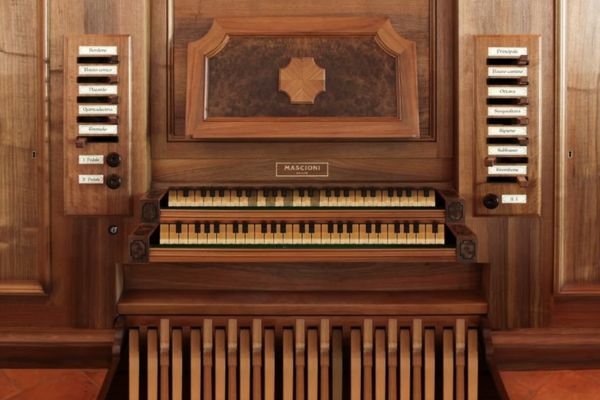
Organs typically have two or three keyboards. Handel, Purcell, Clarke, Blow, and Bull were among the principal composers.
Ready to discover more? Dive deeper into the history of English organs by reading Keith A Morgan The Evolution of the Early English Organ. Get your copy today!